Kellyjev kriterijum i rulet
Kellyjev kriterijum kaže kockaru koji ima prednost koliko da uloži. Za rulet daje jasan odgovor: ništa.

Kellyjev ulog = prednost / izgledi. Uz negativnu prednost formula daje negativan udeo, što znači: ne kladite se. Kriterijum je ipak koristan da se razume zašto su igrači na pristrasne točkove određivali uloge baš tako kako jesu i zašto svi ostali treba da ih određuju prema budžetu.
Kriterijum
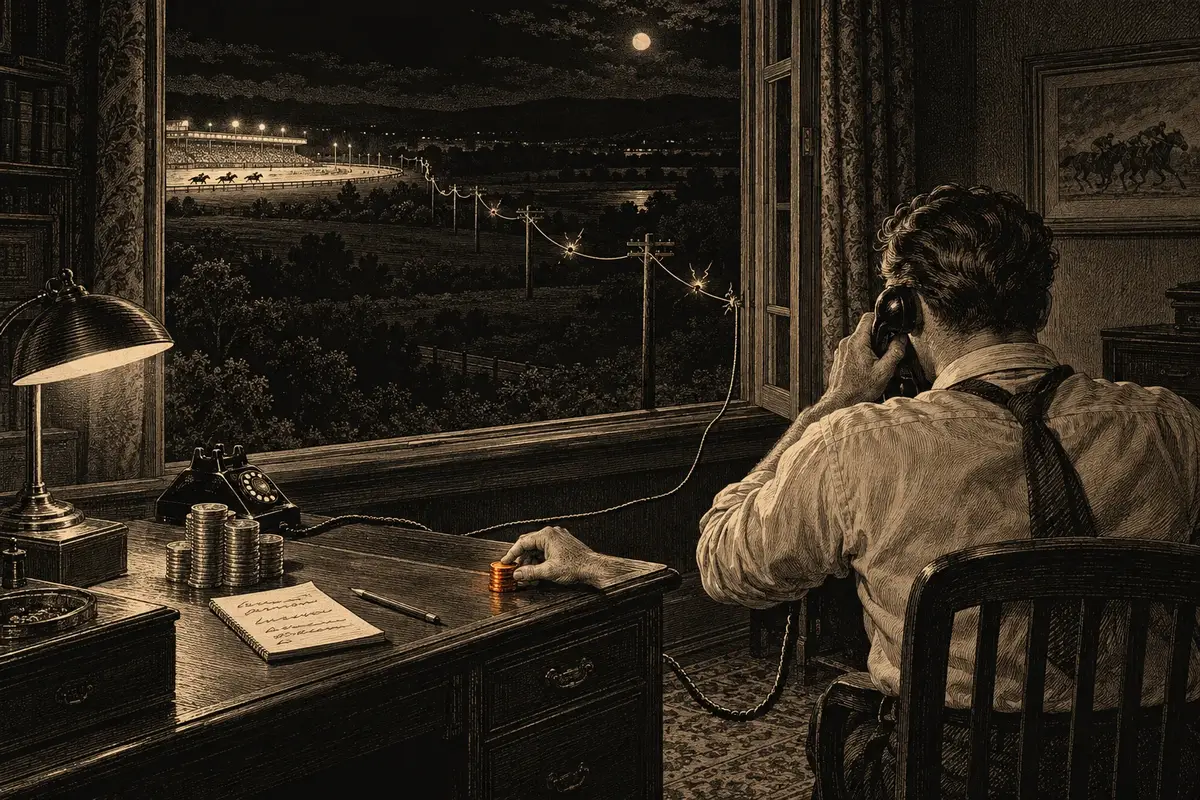
John Kelly (1956) asked how a gambler with a known edge should size bets to maximize long-run growth of the bankrollnovacBankrolUkupan iznos odvojen za igru. Upravljanje bankrolom znači odlučiti koliki njegov deo rizikujete po opkladi i po sesiji.Pročitaj ceo tekst →. The answer, for a bet paying b to 1 with win probabilitymatematikaVerovatnoćaKoliko je neki ishod moguć, od 0 do 1 ili od 0% do 100%. Jedan broj: 1/37 = 2,70%.Pročitaj ceo tekst → p and loss probability q = 1 − p, is to stake the fraction f* = (bp − q) / b of the bankroll. Positive f* means bet that fraction; zero or negative means do not bet. Kelly worked at Bell Labs, and his paper, “A new interpretation of information rate”, set the problem in Claude Shannon’s theory of information: a gambler who gets tips over a noisy line, at fair odds, can grow the bankroll at best at the rate the line carries information. This is a growth objective under a probability model, not a promise to finish ahead after a particular number of bets. A spending limit, finite deadline or payoutnovacIsplataOno što dobitna opklada donosi, izraženo kao „X prema 1“ povrh vraćenog uloga.Pročitaj ceo tekst → cap changes the decision problem.
Kellyjevo klađenje u ruletu
For redopkladaCrvenoProsta šansa na 18 crvenih brojeva. Francuski: rouge.Pročitaj ceo tekst →: b = 1, p = 18/37, q = 19/37; f* = (18/37 − 19/37)/1 = −1/37. For a straight upopkladaJedan brojJedan jedini broj, isplaćuje 35:1.Pročitaj ceo tekst →: b = 35, p = 1/37, q = 36/37; f* = (35/37 − 36/37)/35 = −1/1295. Every standard bet gives a negative Kelly fraction, because every bet has a negative edge, and the growth-optimal stake is zero. Kelly betting on roulette is a formal way of saying what the house-edge page says: no positive stake maximizes expected logarithmic growth when the bet has negative expectation. A particular session can still end in profit. La partagepraviloLa partageFrancusko pravilo: kada padne nula, vraća se polovina uloga na prostu šansu. Prepolovljuje prednost kuće na tim opkladama, na 1,35%.Pročitaj ceo tekst → needs a separate three-outcome calculation: a win, a full loss or a half-loss on zerotočakNulaJedini zeleni džep koji ne pokriva nijedna prosta šansa ni opklada na tuce ili kolonu; izvor prednosti kuće. Takođe: jedna nula, 0.Pročitaj ceo tekst →. Its expected log growth also falls as the stake increases from zero.
Gde se Kelly zaista primenjivao
Suppose a pocketopremaDžepJedno od 37 numerisanih udubljenja na rotoru. Takođe: pregradak, čašica.Pročitaj ceo tekst → really has a stable, known probability of 1 in 30 and pays 35 to 1. The Kelly fraction is 0.57%: about $57 from a $10,000 bankroll. Under independent spinsmatematikaNezavisni spinoviSvaki spin ima iste verovatnoće bez obzira na istoriju. Osnova svakog proračuna na ovom sajtu.Pročitaj ceo tekst → and exact fractional staking, the geometric growth factor over 1,000 spins is about 1.7. Expected bankroll grows faster because rare large wins pull up the average. These are model calculations, not evidence that any named historical player used Kelly or achieved this result.
Tipično i prosečno
The gap between the typical bankroll and the average one is wide. Take a pocket that hits 1 time in 25, a hypothetical edge of 44% per unitnovacJedinicaOsnovni ulog u kojem računa sistem ili igrač. Progresije se opisuju u jedinicama da bi važile za svakim stolom.Pročitaj ceo tekst → staked. Kelly stakes 1.26% of the bankroll on it. After 1,000 spins the typical bankroll has grown about 11.5 times, while the average, pulled up by a few very lucky runs, has grown about 249 times. Betting more than Kelly raises the average and lowers the typical result: at twice the Kelly stake the typical bankroll only doubles, and by two and a half times the Kelly stake it shrinks, although every bet still carries a 44% edge. In this example, half-Kelly retains about 78% of the expected log growth. This fraction depends on the probabilities and payout.
Kada je prednost nagađanje
Kelly uses the true probabilities, but a player usually has only estimates. Selecting the busiest pocket from a past record creates a selection problem: even a fair wheel has a busiest pocket. Its observed rate can overstate its future probability. Choosing the stake from that same record compounds the error. An independent follow-up sample helps test a proposed bias (see How to Detect Roulette Wheel Bias). Reducing the calculated fraction reduces exposure, but cannot turn a false edge into a real one.
Ljudi sa prednošću
Haghani and Dewey (2016) studied 61 participants given $25 and 30 minutes to bet on a simulated coin with a disclosed 60% chance of heads. The payout cap was $250; its value was revealed when a proposed winning bet would reach it. Their reported 21% success category included balances of at least $200, while the 28% “bust” category meant less than $2, not necessarily zero. Eighteen participants bet their entire balance on one flip. The uncapped Kelly fraction is 20%, but the cap and deadline change the optimization problem. The experiment illustrates how stake choices matter even with a known advantage; it does not establish one best strategy for every objective.
Šta koristiti umesto toga
Bez prednosti, određivanje uloga je pitanje budžeta, a ne rasta: ulog = koliko ste spremni da potrošite po spinu, izvedeno iz budžeta po satu i tempa stola (stranica o upravljanju bankrolom). Kellyjev doprinos običnom igraču je jasnoća njegovog odgovora: nula. Sve što uložite iznad nule je cena igranja, koju birate vi, a ne neka formula koja je optimizuje.
Napomena o delimičnom Kellyju i „upravljanju novcem“
Betting a fixed percentage of the current bankroll is proportional staking: the stake rises after wins and falls after losses. Flat bettingstrategijaStalni ulogUlaganje istog iznosa u svakom spinu. Osnova sa kojom se poredi svaka progresija.Pročitaj ceo tekst → instead keeps the cash stake fixed. Neither creates an edge on ordinary roulette. With infinitely divisible stakes and a fraction below 100%, proportional staking never reaches exactly zero in finitely many losses, but the balance can become arbitrarily small. Real table minimums can prevent further play much sooner. The growth-optimal fraction remains zero.
Formula
Pitanja
Only when the actual probabilities, payouts and conditions give a credible positive advantage. Standard bets on an unbiased wheel have no such advantage.
Using half the calculated fraction reduces exposure to errors in the estimated edge. The familiar three-quarters-growth rule is an approximation for small advantages, not a universal identity. It does not protect against an edge that does not exist.
Ne. Kelly optimizuje rast kada prednost postoji. Upravljanje bankrolom kontroliše potrošnju kada je nema.
Matematika iz zabave
Prvo pokušajte sami. Svako rešenje je sklopljeno; otvorite ga kada budete spremni.
Suppose a hypothetical bet on one number has a known 44% edge under standard payoutsnovacIsplataOno što dobitna opklada donosi, izraženo kao „X prema 1“ povrh vraćenog uloga.Pročitaj ceo tekst → and independent spinsmatematikaNezavisni spinoviSvaki spin ima iste verovatnoće bez obzira na istoriju. Osnova svakog proračuna na ovom sajtu.Pročitaj ceo tekst →. Kelly gives a 1.26% bankrollnovacBankrolUkupan iznos odvojen za igru. Upravljanje bankrolom znači odlučiti koliki njegov deo rizikujete po opkladi i po sesiji.Pročitaj ceo tekst → fraction. What if the same 44% edge came on one bet spread over five neighboring numbers?
Prikaži rešenje
Odgovor Tada Kelly kaže 7,1% bankrola, a bankrol raste skoro šest puta brže: oko 1,25 miliona puta za 1.000 opklada, prema oko 11,5 puta.
A straight upopkladaJedan brojJedan jedini broj, isplaćuje 35:1.Pročitaj ceo tekst → with a 44% edge wins with chance 0.04, since 36 × 0.04 = 1.44. Kelly’s stake is the edge divided by the odds: 0.44/35 = 1.26%. The typical growth per bet is 0.04 × ln(1 + 35 × 0.0126) + 0.96 × ln(1 − 0.0126) ≈ 0.00244, so 1,000 bets multiply the bankroll by about e^2.44 ≈ 11.5.
Spread one stake over five numbers and the bet wins with chance 0.20 and pays 36/5 for 1, that is 6.2 to 1: still a 44% edge, since 0.2 × 7.2 = 1.44. Kelly’s stake becomes 0.44/6.2 = 7.10%, and the growth per bet 0.01404, about 5.75 times as much. Over 1,000 bets that is e^14.04, about 1.25 million.
The edge is the same; the swings are smaller. A bet that wins one time in five has a larger growth-optimal fraction in this model, although losses can still reduce the bankroll severely. This comparison assumes the same known edge for both bets; actual predictions need independent evidence.
Assume two numbers are adjacent on the betting layoutopremaTabla za ulogeOdštampana mreža za uloge na stolu. Takođe: sto, čoja, platno.Pročitaj ceo tekst → and each has a stable, known probabilitymatematikaVerovatnoćaKoliko je neki ishod moguć, od 0 do 1 ili od 0% do 100%. Jedan broj: 1/37 = 2,70%.Pročitaj ceo tekst → of 1 in 25 on independent spins. Compare a splitopkladaSplitDva susedna broja, isplaćuje 17:1.Pročitaj ceo tekst → between them at 17 to 1 with equal straight-up stakes on the two numbers. How much does Kelly say, and how fast does the bankroll grow compared with one such pocketopremaDžepJedno od 37 numerisanih udubljenja na rotoru. Takođe: pregradak, čašica.Pročitaj ceo tekst →?
Prikaži rešenje
Odgovor Nema razlike: 2,59% bankrola na split ili 1,29% na svaki broj. Tipičan bankrol raste oko 155 puta za 1.000 spinova, prema 11,5 puta sa jednim džepom.
The split wins with probability 2/25 = 0.08 and pays 17 to 1, so it returns 18 × 0.08 = 1.44 per unitnovacJedinicaOsnovni ulog u kojem računa sistem ili igrač. Progresije se opisuju u jedinicama da bi važile za svakim stolom.Pročitaj ceo tekst → staked: an edge of 44%, the same as one biased pocket. Kelly’s stake is the edge divided by the odds: 0.44/17 = 2.59%.
Two straight-up bets of 1.29% each give exactly the same results. When either number comes up, one chipnovacŽetonPločica koja predstavlja utvrđen iznos i postavlja se na tablu za uloge da bi se napravila opklada. Takođe: cheque.Pročitaj ceo tekst → wins 35 to 1 and the other is lost, a net of 34 × 1.29% = 44% of the bankroll, as the split pays; when neither does, both are lost.
The growth per spin is 0.00505, against 0.00244 for one pocket, so over 1,000 spins the typical bankroll grows e^5.046 ≈ 155 times rather than e^2.44 ≈ 11.5 times. The geometric growth factor is larger because the combined bet wins more often at the same 44% edge. It is a model result, not a guaranteed bankroll.
Za predah
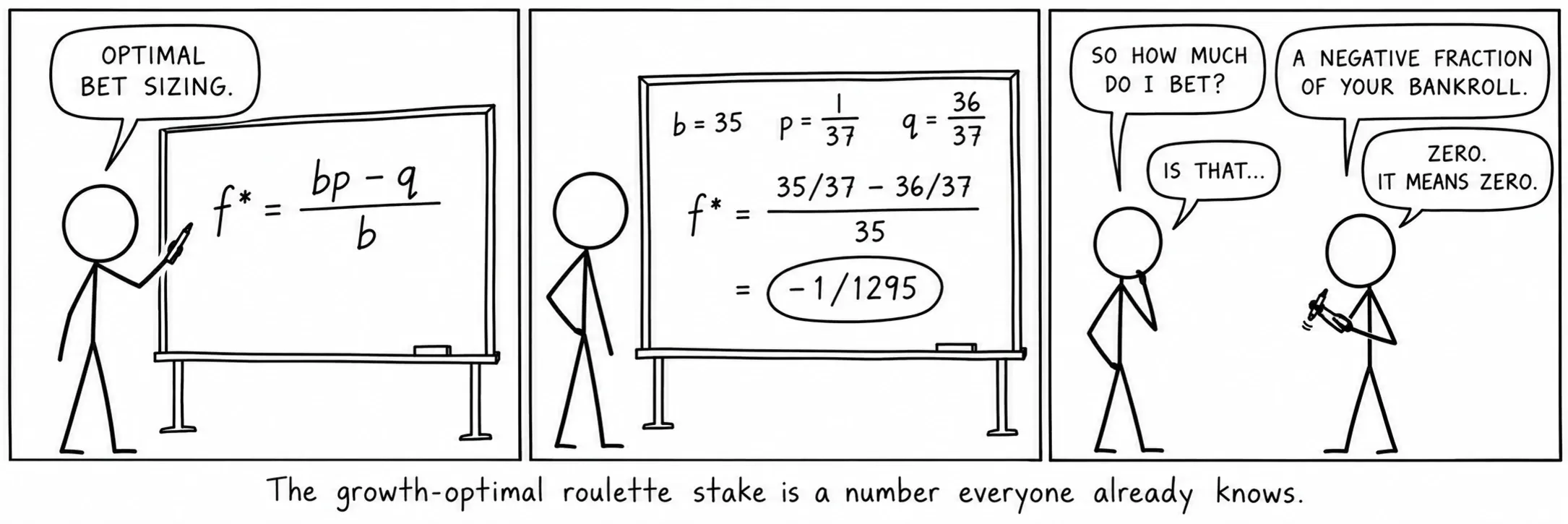
Ulog na rulet optimalan za rast je broj koji svi već znaju.
Izvori
- Kelly, J. L. „A new interpretation of information rate.“
- Breiman, L. „Optimal gambling systems for favorable games.“
- Thorp, E. O. „Optimal gambling systems for favorable games.“
- Thorp, E. O. The Mathematics of Gambling.
- Epstein, R. A. The Theory of Gambling and Statistical Logic, 2nd ed.
- Taylor, D. G. Games, Gambling, and Probability: An Introduction to Mathematics, 2nd ed.
- Ethier, S. N. The Doctrine of Chances: Probabilistic Aspects of Gambling.
- Haghani, V. & Dewey, R. „Rational decision-making under uncertainty: observed betting patterns on a biased coin.“