Istorija sistema za rulet
Dva veka ljudi koji zapisuju pravila za menjanje svog uloga.
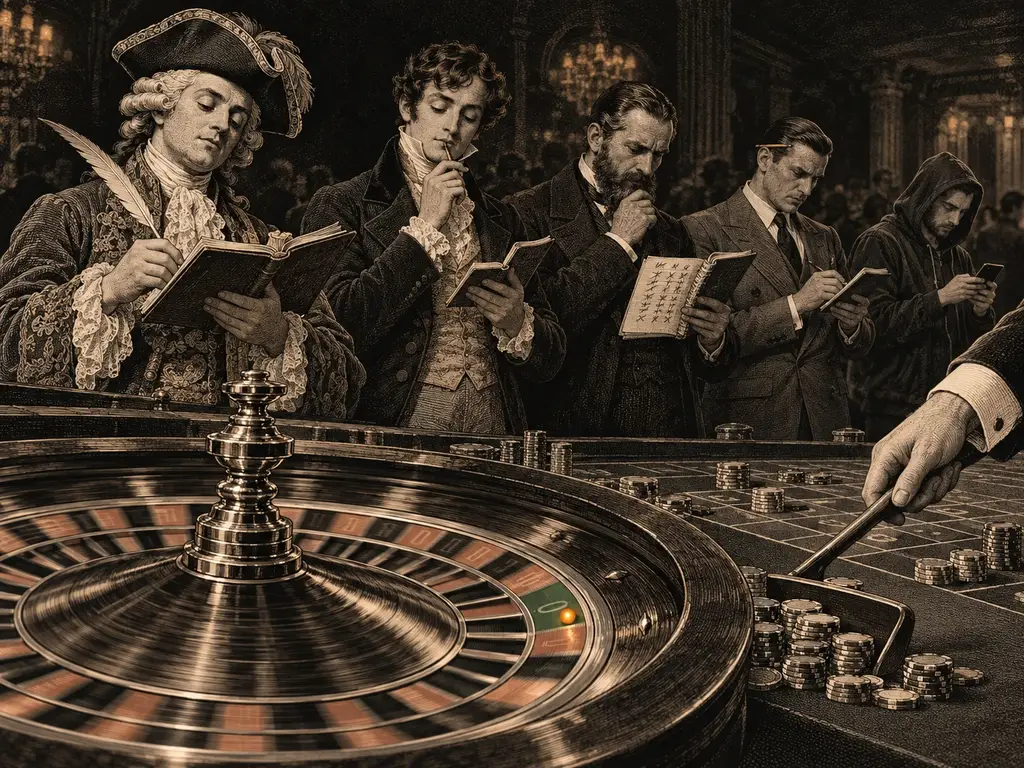
Martingale potiče iz 18. veka; D’Alembert nosi ime matematičara koji ga nije voleo; Labouchère je hobi jednog viktorijanskog političara. Ni tada nijedan od njih nije funkcionisao.
Martingale
The 1762 Académie française dictionary records martingalestrategijaMartingaleProgresija koja udvostručuje opkladu posle svakog gubitka. U odeljku Strategija pogledajte šta ona čini, a šta ne.Pročitaj ceo tekst → as a gambling term for staking what has been lost. Its 1878 edition explicitly describes doubling after a loss and also uses the word more broadly for betting schemes. These entries document usage; they do not identify a single inventor.
Today the familiar doubling progressionstrategijaProgresijaSvako pravilo koje menja ulog na osnovu prethodnih rezultata. Negativne progresije ga povećavaju posle gubitaka, pozitivne posle dobitaka.Pročitaj ceo tekst → aims to recover previous losses and gain one starting unitnovacJedinicaOsnovni ulog u kojem računa sistem ili igrač. Progresije se opisuju u jedinicama da bi važile za svakim stolom.Pročitaj ceo tekst → when a win arrives. A finite bankrollnovacBankrolUkupan iznos odvojen za igru. Upravljanje bankrolom znači odlučiti koliki njegov deo rizikujete po opkladi i po sesiji.Pročitaj ceo tekst → or table limitstoLimit stolaNajmanja i najveća dozvoljena opklada. Maksimum je ono što zaustavlja progresije sa udvostručavanjem.Pročitaj ceo tekst → can stop the sequence first. The Strategy section shows how those limits affect a session.
D’Alembert
The progression bearing d’Alembert’s name raises the stake by one unit after a loss and lowers it after a win. The name alone does not prove who devised or endorsed the betting rule.
Its mathematical issue is straightforward: on independent spinsmatematikaNezavisni spinoviSvaki spin ima iste verovatnoće bez obzira na istoriju. Osnova svakog proračuna na ovom sajtu.Pročitaj ceo tekst →, a run of one outcome does not make the opposite outcome due. A famous namesake does not change that assumption or the payoutnovacIsplataOno što dobitna opklada donosi, izraženo kao „X prema 1“ povrh vraćenog uloga.Pročitaj ceo tekst →.
Labouchère
The cancellation system uses a list of numbers to determine the next stake. A win removes entries and a loss adds an entry; the Strategy section sets out the rules and examples. Historical stories about its namesake should be distinguished from evidence that the method creates an advantage.
A sequence may clear with a profit, but a losing run can leave a growing list and larger required stakes. How often it clears depends on the starting list, bankroll, limits and stopping rule. There is no universal success percentage.
20. vek
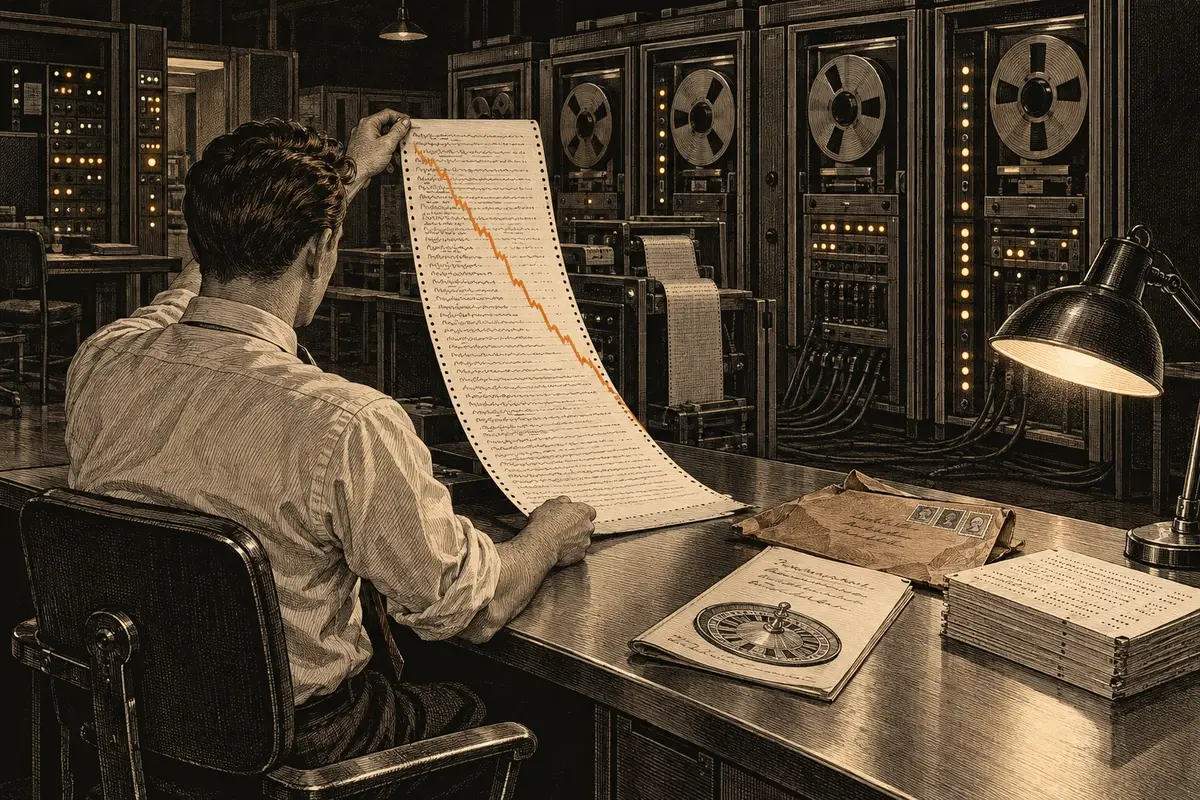
A simulation can show how a specified system behaves under a chosen wheel model. It cannot test every possible rule, and a finite run need not return exactly the theoretical house edgematematikaPrednost kućeDeo svakog uloga koji kazino u proseku zadržava: 2,70% u evropskom ruletu.Pročitaj ceo tekst →.
For independent uniform single-zerotočakNulaJedini zeleni džep koji ne pokriva nijedna prosta šansa ni opklada na tuce ili kolonu; izvor prednosti kuće. Takođe: jedna nula, 0.Pročitaj ceo tekst → spins with standard full-loss-on-zero payouts, each unit staked has expected net return −1/37. For a bounded session whose stakes are chosen using information available before each spin, adding the conditional expectations gives expected lossmatematikaOčekivani gubitakOčekivana vrednost pomnožena ukupno uloženim iznosom; prosečan iznos izgubljen tokom sesije ili perioda.Pročitaj ceo tekst → equal to 1/37 of expected turnovernovacPrometUkupno uloženi iznos tokom sesije ili perioda, računajući i ponovo uložene dobitke. Takođe: handle, action.Pročitaj ceo tekst →. Stopping or changing stakes can change the distribution of results, but not create positive expectation under those assumptions. Other payouts, such as la partagepraviloLa partageFrancusko pravilo: kada padne nula, vraća se polovina uloga na prostu šansu. Prepolovljuje prednost kuće na tim opkladama, na 1,35%.Pročitaj ceo tekst →, need their own calculation.
Mit: strategija u ruletu koja uvek pobeđujeFibonacci strategija u ruletu
Zašto opstaju
A demonstration can end in profit without showing that the method has an edge. Some rules favor frequent small wins at the cost of occasional large losses; others do the reverse. The proportions depend on the exact rules and limits.
When comparing systems, look at all completed sessions, total stakes, losses and stopping conditions. A selected winning example leaves out the information needed to assess the claim.
Sistemi na prodaju
Systems have also been sold with elaborate names and entry rules. The examples below illustrate the arithmetic of specific rules; they are not evidence of who first invented or marketed them. Waiting for a pattern does not alter the next independent spin’s probabilities.
Onaj koji nije sistem
Pravila zaustavljanja: unapred odlučiti koliko izgubiti ili dobiti, pa otići. Često se prodaju kao deo sistema i jedini su deo koji išta postiže, jer smanjuju promet. Nisu nazvana ni po kome, što im i priliči.
Pitanja
Martingale, za vek ili više. Udvostručavanje posle gubitka prva je ideja koja svakome padne na pamet.
D’Alembert je tome bio najbliži, slučajno. Pascal, Fermat, Huygens, Bernoulli i Laplace objasnili su zašto sistemi ne uspevaju.
Zato što se većina sesija završi dobitkom, a video sesije sa dobitkom jeftino je snimiti.
Za predah

Dva veka imena. Jedan broj.
Izvori
- Thorp, E. O. „Optimal gambling systems for favorable games.“
- Thorp, E. O. The Mathematics of Gambling.
- Doob, J. L. „Note on probability.“
- Halmos, P. R. „Invariants of certain stochastic transformations: the mathematical theory of gambling systems.“
- d’Alembert, J. „Croix ou pile.“
- Schwartz, D. G. Roll the Bones: The History of Gambling.
- Kavanagh, T. M. Dice, Cards, Wheels: A Different History of French Culture.
- Bollman, M. Mathematics of the Big Four Casino Table Games: Blackjack, Baccarat, Craps, & Roulette.
- Académie française, martingale, 1762
- Académie française, martingale, 1878